Ron Pullins
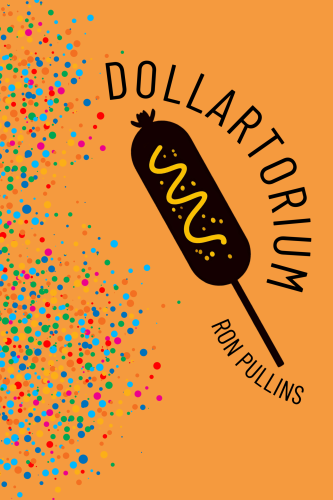
Dollartorium
The rich are getting richer and the poor are getting screwed.
Ralph makes world-class corndogs in a small Kansas shop. It’s humble work, but honest. The problem? The bills pile up faster than the money rolls in, and Ralph can’t help but notice the widening gap between the haves and the have-nots.
Ralph’s wife has had enough. She’s determined to get rich, one way or another. So when an infomercial for the “Dollartorium” promises untold wealth through a few simple business courses, Ralph reluctantly agrees to give it a shot.
Soon he’s learning how to hire, fire, market, and hustle his way to success. When the entire Dollartorium empire inevitably collapses under the weight of its own greed, Ralph must find his way back to what really matters: honest work, family, and the best damn corndogs in Kansas.
Now Available
Praise for Dollartorium
“A boisterous and thoughtful journey through the absurdities of modern capitalism.”
—Kirkus Reviews
“The book reads almost like a modern fable, which points out how empty corporate talk can fool people who are ambitious for success.”
—Independent Book Review
“Ron Pullins’ Dollartorium is an absolute delight, bursting with imagination and wit that transforms a story about money and ambition into pure enjoyment.”
— Readers’ Favorite
“Ron Pullins’s Dollartorium is a fable of sorts about the dangers of unbridled capitalism and greed and the reward of honest work.”
—Blue Ink Review
“Like Orwell’s Animal Farm, Catch 22, and Gulliver’s Travels, Dollartorium is a deceptively simple story that belies the complicated truth of capitalism.”
—Novels Alive
“Beyond the surface, Ron Pullins’ mentally-stimulating novel Dollartorium advocates for a community-centered approach to growth and success rather than the pursuit of selfish individual desires. It emphasizes the restoration of values and principles centered on bringing our humanity to the fore through shared success, healthy relationships, and love for each other.”
—Independent Book Review
The novel closes on a note that is satisfying, though far from idyllic. That choice feels intentional. Pullins has more to say than a neat ending would allow. Through his characters, he gives voice to frustrations that have become commonplace, about inequality, exploitation, and the illusion of easy fixes. The odds remain stacked against the little guy, and the allure of grand, risky schemes proves hard to resist. Dollartorium captures that tension with clarity, humor, and an undercurrent of quiet anger that makes it linger after the final page.
—Literary Titan
“Dollartorium is a boisterous, thoughtful journey through the absurdities of modern capitalism that will particularly resonate with readers who question the relentless pursuit of wealth and value the dignity of honest work.”
—Book Below
“In the entertaining satirical novel Dollartorium, a family’s sense of good fortune evolves as they learn to recognize the burdens of serving two masters.”
—Foreword Reviews, Clarion Review
“Pullins utterly skewers our era of death rattle capitalism. Like the great satirists before him, you don’t know if you should laugh or cry–or both. Fun read, fun ride. We might as well giggle on our way to ruin.”
—Joshua Mohr, author of Model Citizen
“The Dollartorium is an allegory for our times, a surreal meditation on the illusions, and delusions, that underpin late-stage capitalism and a society in which almost every relationship is monetized. It depicts an American Dream turned nightmare, while celebrating beacons of integrity and love in turbulent times, as well as the possibility of awakening. It provides an unsparing look at rampant greed and still radiates hope in the human spirit.”
—Alice Hatcher, author of The Wonder that was Ours
“Wow. You won’t find satire more hilarious and innovative than Dollartorium. A comic fable-for-our-times, the novel takes Ralph, a humble maker of corndogs, on a Bunyan-like journey to the ugly underbelly of late-stage capitalism, exposing the scourge of contemporary business culture while keeping us rooting for honest work, family, and the best battered-and-fried weenie in Kansas. Kudos to Ron Pullins for his imagination and unique comic sensibility!”
—Nancy Crochiere, of Graceland
Playlist for Dollartorium
Dear Reader: If you have read the book, or are reading it, here is some music to put you in the mode. They help me create my writing environment. The songs can be accessed through Youtube as well.
Writing the Dollartorium was an exercise in anger which I hoped to temper with satire, absurdity and a sense of hope at the beginning and end. These songs reflect the satire I felt or the values that underlie my own feelings and something of my own reaction to the events of the novel, both the good and the not so good. This list reflects the many tones in the book. We are deeply affected, personally and as a society, by the growth of money culture and the values instilled by our capitalistic and materialistic cultural milleau.
1. “Corn Dog Blues" by Robin Williams
Nothing like a little country blues to set the tone for the world of this novel which opens on Ralph’s little corn dog shop in rural Kansas where he makes and sells the best corn dogs in the world, a peaceful, if not somewhat sad Midwestern world, a mixture of blues and yearning for understanding (Plato) soon to be disturbed by the advent of the Money Master.
2. “Corn Dogs” by Ryan Shupe and The Rubberband
On the other hand we are talking about corn dogs, so there is an underlying humor in centering the story around making the perfect corn dog. Yet, those corn dogs are mighty tasty to some of us. So let’s not forget that this satire, and funny, and that the novel is centered on a bit absurdity. Ralph’s shop is, after all, the Corny Doo Doggery.
3. “Money, Money” by Liza Minnelli and Joel Grey
Well, here comes the Money Master, hopping out of television and dancing on the counter at the Corny Doo Doggery with a weltanschauung appropriate for those yearning to be rich. You can almost feel this is The Weimar Republic the Money Master is promising.
4. “Billionaire” by Travie McCoy feat. Bruno Mars
The aim of the Dollartorium is to produce billionaires. This could be Phyllis’ song, her desire, her dream, her fantasy for wealth and a desire to be part of the elite.
5. “Hammond Song” by The Roaches
Stella implores her father not to leave for the Dollartorium, sensing the danger of him being lost to the world of the Dollartorium such that he might never come back. The Roaches sing in both crystal clear voices, but carry a full set of emotional complex feelings.
6. “Fame and Wealth” by Loudon Wainwright III
This is the Sycophant’s song. Ralph meets him at the entryway to the Dollartorium. This song reflects his attitude. I love it that it is a lonely cry. Such is the result of selfish greed studied and learned.
7. “Banks of Marble” by Pete Seeger
Ralph studies business institutions and practices at the Dollartorium, including banks, bankers, money and loans. “Banks of Marble” captures a more serious tone in a 1930s protest song. The novel is satire as protest. I frequent many of the protest songs of the era. It is a call to action.
8. “Little Boxes” by Pete Seeger
Like the Dollartorium, this Pete Seeger song of satire expresses a world awash in marketing and perfunctory work, all standard and without quality, like frozen corn dogs, another lesson from the Dollartorium.
9. “Rich People” by Carsie Blanton
Another social critique of the rich.
10. “Selling Out" by Tom Lehrer
Ralph eventually becomes convinced that the Dollartorium way is the way for him, and he sells out.
11. “Money” by Pink Floyd
Once inside the Dollartorium when Ralph gets his own money machine and pumps it, like the many others pumping their own money machines, attempting to get rich, the tone changes, and here we experience a sardonic take on the corrupting power of money. It’s an unsustainable world, discordant, crazy making.
12. “What Did you Learn in School Today?” by Pete Seeger
Off Ralph goes to the Dollartorium to learn a few lessons in getting rich, not unlike the lessons Tom Lehrer finds students learning about government, power and abuse. The lessons of how to get rich, why to get rich, the benefits of the power that comes from the accumulation of wealth are as subtle, but as persuasive.
13. “Danny’s Song (Even though we ain’t got money)” by Loggins and Messina
To ease the angst I use sometimes bitter satire, but I also think there is value in love and lives lived out from under the pressure of money. I wanted to end the work on a positive and human note. This song reflects that. Hopefully it becomes Ralph’s and Phyllis’ song.
14. “Big Yellow Taxi” by Joni Mitchell
After the collapse of the Dollartorium, Ralph and Stella return to the simple, honest work of making corn dogs, realizing the value of what they had all along. This song works as the warning sign for all who are tempted to enter the Dollartorium.